By Alison Deviney, postdoctoral researcher at North Carolina State University
It’s not that we don’t know how to remove phosphorus from water. Indeed, the science of phosphorus removal from municipal waste and environmental waters has advanced considerably over the past decade. Sorbents, engineered media, hybrid wetland systems, agricultural bioamendments, and other recovery technologies exist or are being developed with excellent promise, both under the controlled conditions of lab settings and in the field. What then, is preventing widespread adoption of these technologies? Is it a lack of awareness, product availability, and/or cost? Are there regulatory or social barriers? Are the application contexts too specific for broader use?
With support from the National Science Foundation, a team of researchers from University of Florida, North Carolina State University, and the Sustainable Phosphorus Alliance designed the Technologies and Treatment for Phosphorus Mitigation (T2PM) Workshop to help answer these questions, bringing together experts from industry, academia, and regulatory agencies to better understand the challenges—and opportunities—that exist for broader phosphorus management tools and strategies within the South Florida context. You can read our full report here [link to come] and find some highlights below.
South Florida as a Case Study
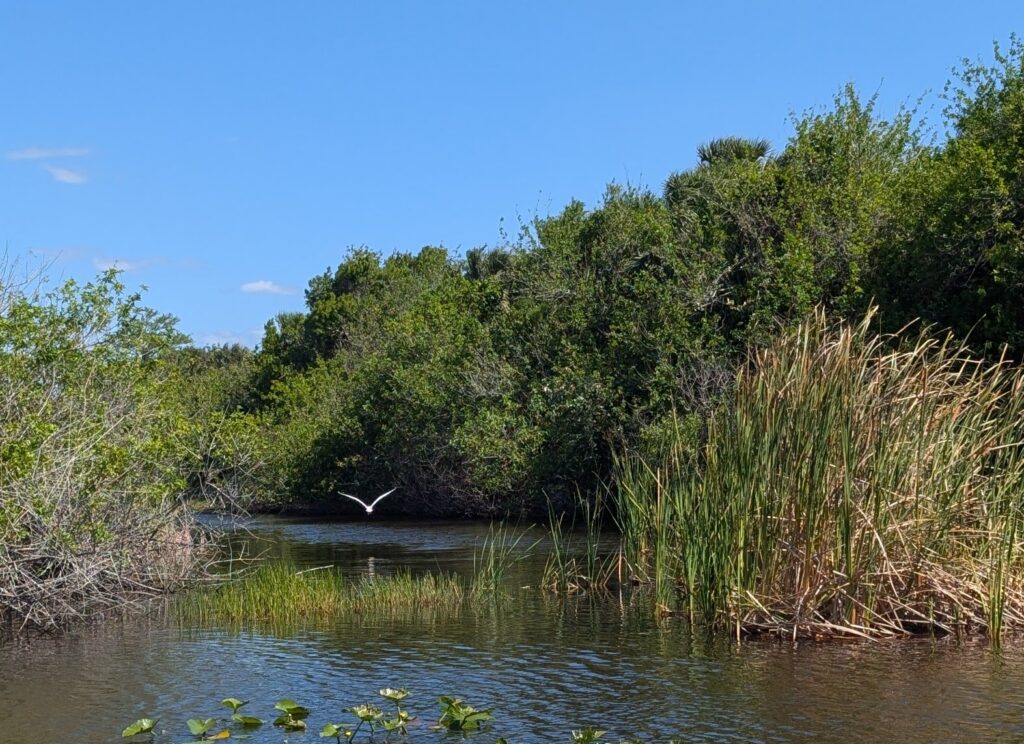
Lake Okeechobee, Florida’s largest freshwater lake, connects the Kissimmee River from the north to the Greater Everglades watershed, one of the largest wetland ecosystems in the world, supplying freshwater to 9 million Floridians. Intensive development over the past century has had significant impact on these surface waters, from drainage and management through an extensive engineered canal system to high nutrient inputs from agricultural and urban runoff. These inputs into the historically low-nutrient Everglades drove these pristine ecosystems to the brink of collapse, prompting federal involvement and the passage of the 1994 Everglades Forever Act to restore ecosystem balance. This in turn has led to the establishment of the Stormwater Treatment Areas (STAs) and best management practices (BMPs) for agriculture, which have been extremely successful. South Florida Water Management District data indicates that 90% of the Everglades now meets the 10 ppb limit for phosphorus (www.sfwmd.gov/our-work/wq-stas). Still, reaching the stringent phosphorus discharge targets across all treatment areas remains an ongoing challenge.
Bringing Stakeholders Together
Despite the success of the Everglades Forever Act in establishing the STAs, agricultural BMPs, and other practices, the complexity of this environmental remediation challenge is a multi-sectoral coordination problem that cannot be solved by regulation alone. Technology developers may have performance data but lack regulatory context or end-user knowledge. Researchers can identify knowledge gaps but rarely control deployment decisions. Water managers and agricultural operators know what can realistically be installed, maintained, and afforded, but may not be tracking what’s emerging from the lab. Regulators set the targets that define what “good enough” looks like in practice, but may depend on others to generate the evidence needed to evaluate new approaches. The translation gap from pilot to field, in other words, is partly a relationship gap between stakeholders.
The T2PM workshop was designed to bridge this lack of cross-sector communication. But first we needed to understand who should be in the room and what they actually needed from the conversation. A pre-workshop survey of our networks revealed that cost and scalability were near-universal concerns across sectors — but that developers and end users weighted other priorities quite differently, signaling that structured dialogue, not just information sharing, would be critical for building shared understanding of the practical challenges involved. From there we worked to assemble a participant mix that included extension agents with boots-on-the-ground knowledge of local agricultural and community realities, researchers working on emerging technologies, government professionals versed in the policy landscape, and technology business leaders from within and beyond South Florida.
What We Learned
Across the two days of presentations, field visits, and structured discussion, several themes emerged from the workshop that suggest greater alignment among stakeholders than participants may have initially expected.
- The gap between lab and field is real. Participants broadly recognized a range of existing or near-ready phosphorus mitigation technologies, indicating that the bottleneck is not a lack of treatment options. Rather, the need for accessible financing structures, supportive policy, and context-specific strategies will determine whether a technology is actually deployed and sustained in the field. This multi-level challenge makes early collaboration between researchers and end users — water managers, regulators, and agricultural operators — essential to developing approaches that are viable beyond the lab.
- No single technology will do the job. Participants agreed that effective phosphorus management requires integrating multiple technologies tailored to specific contexts. For example, biochar and sorbent media may be well-suited for edge-of-field interception of agricultural runoff, while chemical treatments such as alum or lanthanum-modified materials may be more appropriate for managing nutrient flows within the canal system, and hybrid constructed wetland systems offer options for polishing water at larger scales before it reaches sensitive receiving waters. The “flashy” flow dynamics of South Florida’s wet and dry seasons — compounded by hurricanes — add an additional layer of hydrological complexity.
- Legacy phosphorus requires targeted approaches. Standard treatment infrastructure is generally designed to manage incoming phosphorus loads, not to address phosphorus that has accumulated over decades in saturated sediments and historically impaired waterbodies. When these sediments reach capacity, they can shift from acting as a phosphorus sink to a source — releasing phosphorus back into the water column and undermining treatment gains elsewhere. Approaches discussed for addressing this challenge included soil management strategies such as chemical amendment, capping, and soil inversion within treatment wetland systems, as well as targeted treatment of high-priority hotspots such as dairy lagoon drainage areas and long-impaired lakes.
- Recovery should be part of the solution. Although the workshop focused primarily on phosphorus removal, participants showed genuine interest in phosphorus recovery and reuse as a longer-term strategy, such as struvite precipitation or co-precipitation to produce useful agricultural products. This could offer potential economic return alongside environmental benefit, which several participants found compelling.
- Monitoring remains a foundational gap. Higher-resolution performance data from real-world deployments is needed to evaluate, compare, and ultimately permit new technologies. Grab samples alone are insufficient to capture the variability that characterizes South Florida’s hydrology. Better data infrastructure, shared across sectors, was seen as foundational to progress on everything else.
Parting thoughts…
No single technology will solve the phosphorus problem, and no single sector will either. What the T2PM workshop offered its participants — perhaps as much as the knowledge shared — was a room where collaborative opportunities to make a difference could be explored together. That kind of shared understanding, built across disciplinary and institutional lines, is harder to measure than a removal rate but just as necessary. It is also, ultimately, where the durable solutions to sustainable phosphorus mitigation begins.
Opinions expressed here do not necessarily reflect those of the Sustainable Phosphorus Alliance or its members.